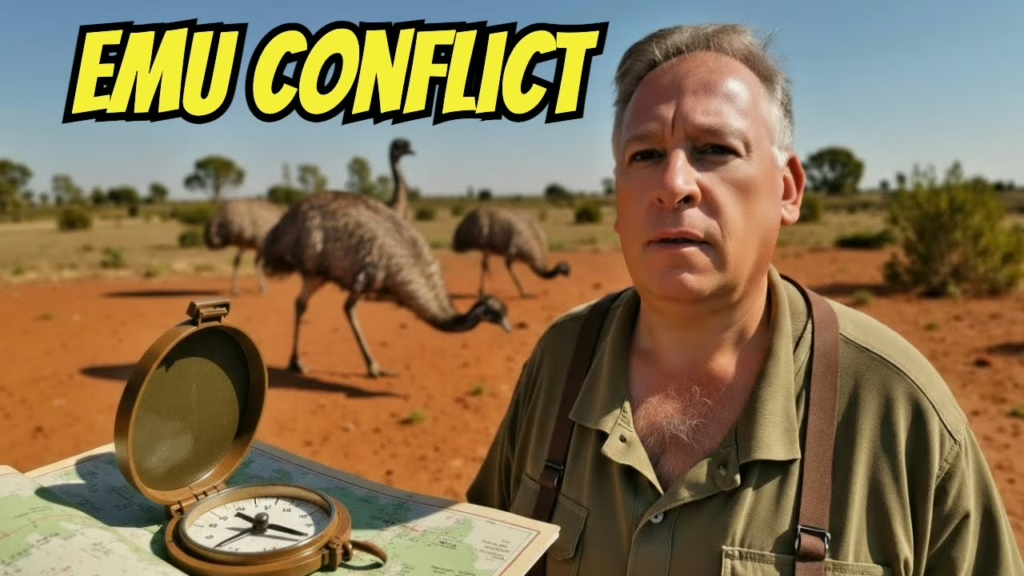
November 1932, and you’re a soldier in the Royal Australian Artillery, armed with Lewis machine guns and thousands of rounds of ammunition, preparing for battle against one of the most formidable enemies the Australian military has ever faced. Your targets aren’t foreign invaders or hostile forces, but 20,000 emus – large, flightless birds that have been systematically destroying wheat crops across Western Australia. What follows will become one of history’s most embarrassing military defeats, as the emus prove to be cunning, resilient opponents who outmaneuver professional soldiers and earn a decisive victory in what newspapers would mockingly call “The Great Emu War.”
This wasn’t just a humorous rural pest control operation but an actual military campaign, complete with official orders, government funding, and detailed after-action reports that documented how Australia’s armed forces were defeated by birds. The Great Emu War stands as one of history’s most absurd conflicts and a perfect example of how human attempts to control nature often backfire in spectacular and humiliating ways.
To understand how Australia found itself at war with emus, we must first understand the unique ecological and economic conditions of Western Australia in the early 1930s. The region had experienced rapid agricultural expansion following World War I, as returning soldiers were granted land under soldier settlement schemes designed to boost food production and provide employment for veterans.
These new wheat farms were carved out of marginal lands in areas that had previously been natural emu habitat. Emus are large, flightless birds native to Australia, standing up to six feet tall and capable of running at speeds of 30 miles per hour. They’re nomadic creatures that traditionally migrated across vast areas in search of food and water, following seasonal patterns that had been established for thousands of years.
The wheat farms represented an irresistible food source for the emus, offering vast fields of nutritious grain that was far more concentrated and accessible than their traditional diet of seeds, insects, and vegetation. The timing of the wheat harvest coincided with the emus’ natural migration patterns, creating a perfect storm of agricultural abundance and hungry birds.
The problem was exacerbated by the severe drought conditions that had persisted across much of Australia during the early 1930s. The drought forced emus to travel further in search of food and water, and the irrigated wheat fields became particularly attractive oases in an otherwise harsh landscape. The birds were literally driven to the farms by environmental necessity.
By 1932, an estimated 20,000 emus had invaded the wheat-growing regions around Campion and Walgoolan in Western Australia. The birds moved in large flocks, systematically destroying crops by eating the grain and trampling the plants. Farmers reported that the emus were not just feeding opportunistically but were engaged in what appeared to be organized campaigns of crop destruction.
The economic impact was devastating for farmers who were already struggling with drought, low wheat prices, and the effects of the Great Depression. Many of these farmers were World War I veterans who had invested their life savings and government grants into establishing their farms. The emu invasion threatened to destroy years of hard work and investment.
Desperate farmers appealed to the government for help, arguing that the emu invasion was a natural disaster that required official intervention. They had tried various methods to protect their crops, including fencing, scarecrows, and shooting individual birds, but these measures proved ineffective against the massive flocks that could simply overwhelm any barriers.
The farmers’ pleas reached sympathetic ears in Perth and Canberra, where officials recognized that the emu problem threatened both agricultural production and the stability of rural communities. However, the solution they devised would prove to be spectacularly misconceived.
Rather than employing civilian pest control methods or providing financial assistance to farmers, the government decided to treat the emu invasion as a military problem requiring a military solution. This decision reflected the post-war mentality that saw military action as an effective response to various domestic challenges.
The operation was officially approved by the Minister of Defence, who authorized the deployment of soldiers and military equipment to combat the emu threat. The mission was assigned to Major G.P.W. Meredith of the Royal Australian Artillery, who was given command of two soldiers armed with Lewis machine guns and 10,000 rounds of ammunition.
The Lewis machine gun was a sophisticated weapon designed for warfare against human enemies. It was capable of firing 500-600 rounds per minute and had been successfully used during World War I against German forces. Military planners apparently believed that such firepower would make quick work of the emu population.
Major Meredith approached the mission with professional seriousness, developing tactical plans for engaging the emu flocks and coordinating with local farmers to identify target areas. The operation was to be conducted in a systematic manner, with the goal of eliminating enough emus to save the wheat crop and demonstrate government responsiveness to rural concerns.
The first engagement took place on November 2, 1932, when Meredith’s forces encountered a flock of about 50 emus near Campion. The soldiers set up their machine guns and opened fire on the birds, confident that modern military weapons would quickly devastate the enemy forces. However, the results were far from what anyone expected.
The emus proved to be surprisingly resilient and tactically sophisticated opponents. When the machine guns opened fire, the birds didn’t panic or freeze like typical prey animals. Instead, they scattered in all directions, running at high speeds in zigzag patterns that made them difficult targets. The soldiers found that their heavy machine guns were poorly suited for tracking fast-moving, dispersed targets.
Even more frustrating was the emus’ apparent ability to withstand multiple bullet hits. The birds were large and hardy, with thick feathers and tough skin that could absorb considerable damage. Reports from the field indicated that emus could continue running even after being hit several times, making it difficult to achieve clean kills.
The emus also demonstrated what military observers described as battlefield intelligence. After the initial encounters, the birds seemed to learn from experience and became more cautious around humans. They posted sentries while feeding and would flee at the first sign of approaching soldiers, making it difficult for Meredith’s forces to get within effective range.
The tactical challenges were compounded by the terrain and environmental conditions. The wheat fields provided little cover for the soldiers, while the emus could use their superior speed and knowledge of the local geography to escape. The birds could also break into smaller groups when threatened, forcing the soldiers to divide their attention and reducing the effectiveness of concentrated firepower.
After several days of frustrating encounters that produced minimal results, Major Meredith requested additional ammunition and reinforcements. His reports to headquarters described the emus as “guerrilla fighters” who were employing hit-and-run tactics that frustrated conventional military responses.
The operation was temporarily suspended after the first week when it became clear that the initial approach was failing. Military leaders reviewed the tactics and decided to modify the strategy, but the fundamental problems remained unchanged. The emus continued to outmaneuver and outlast their human opponents.
When operations resumed in mid-November, the results were equally disappointing. Despite expending thousands of rounds of ammunition, the soldiers managed to kill only a few dozen emus while the vast majority of the population remained intact and continued destroying crops. The birds had adapted to the presence of soldiers and become even more difficult to engage effectively.
The media coverage of the Emu War was merciless in its mockery of the military’s performance. Newspapers across Australia and around the world reported on the conflict with barely concealed amusement, describing how professional soldiers had been defeated by flightless birds. Headlines like “Emus Win Again” and “Feathered Foes Too Fast for Guns” captured the public’s reaction to the debacle.
International media picked up the story as an example of Australian eccentricity and military incompetence. The conflict became a source of national embarrassment and contributed to Australia’s reputation for unusual wildlife encounters and unconventional problems.
Opposition politicians in Parliament used the Emu War to criticize government spending and military priorities. They questioned why resources were being wasted on what they characterized as an expensive failure while real human needs went unmet during the Depression.
Major Meredith’s final report was a masterpiece of military understatement and diplomatic language. He acknowledged that the operation had not achieved its primary objectives but described the emus as “worthy opponents” who had demonstrated “tactical superiority” in the engagement. The report recommended that future emu control efforts should use different methods and approaches.
The official casualty reports showed the extent of the military’s defeat. The soldiers had fired approximately 9,950 rounds of ammunition and killed an estimated 986 emus – a ratio that worked out to about 10 rounds per bird. Given that each Lewis machine gun was capable of firing 600 rounds per minute, this represented an extremely poor efficiency rate.
More embarrassing was the fact that the vast majority of the emu population remained intact and continued to damage crops throughout the harvest season. The military operation had failed to achieve any of its stated objectives while consuming significant resources and generating negative publicity.
The aftermath of the Great Emu War led to important changes in Australian agricultural and wildlife management policies. The government abandoned military solutions to wildlife problems and instead focused on civilian pest control methods, financial assistance to farmers, and habitat management approaches.
Bounty systems were established that paid civilians for killing emus, proving more effective and cost-efficient than military operations. Professional hunters and local farmers working for bounties managed to reduce emu populations more successfully than soldiers with machine guns.
The conflict also highlighted the need for better understanding of Australian wildlife behavior and ecology. Scientists began studying emu migration patterns and developing methods for predicting and managing their movements that didn’t rely on lethal force.
Fencing technology improved as farmers and government agencies developed better barriers to protect crops from wildlife damage. The “rabbit-proof fence” concept was adapted for use against emus, creating physical barriers that were more effective than bullets.
The Great Emu War became part of Australian folklore and national identity, representing the country’s unique relationship with its wildlife and the often absurd challenges of life on an isolated continent. The conflict epitomized the Australian sense of humor about difficult situations and the ability to laugh at failure.
Military historians have studied the Emu War as an example of how conventional military tactics can fail when applied to unconventional problems. The conflict demonstrated the limitations of firepower-based solutions and the importance of understanding the enemy’s capabilities and behavior.
The ecological lessons of the Emu War remain relevant today as Australia continues to grapple with wildlife management issues and human-animal conflicts. The failure of the military approach highlighted the need for comprehensive ecological understanding and adaptive management strategies.
Modern conservation approaches recognize that wildlife conflicts often result from habitat disruption and environmental changes rather than inherent animal behavior. The emu invasion of 1932 was a predictable consequence of agricultural expansion into traditional migration routes during a severe drought.
The economic dimensions of the conflict also provide insights into the challenges of agricultural development in marginal environments. The wheat farms that attracted the emus were themselves products of optimistic agricultural policies that didn’t fully account for environmental limitations.
Climate change and continued agricultural expansion in Australia have created new human-wildlife conflicts that echo the patterns of the Great Emu War. Modern wildlife managers use the lessons learned from the 1932 conflict to develop more effective and humane approaches to these challenges.
The Great Emu War has been commemorated in Australian popular culture through books, films, and tourist attractions that celebrate the absurdity of the conflict while acknowledging its serious underlying issues. The town of Campion has embraced its role in the conflict and attracts visitors interested in this unique piece of military history.
Today, emus remain a protected species in Australia, and their populations have recovered from the various control efforts of the 20th century. The birds continue to occasionally conflict with agricultural activities, but these conflicts are now managed through non-lethal methods that recognize both human economic needs and wildlife conservation requirements.
The Great Emu War stands as one of history’s most unusual military conflicts and a perfect example of how human overconfidence can lead to humiliating defeats. The conflict demonstrated that nature often has its own agenda that doesn’t conform to human plans, no matter how well-armed those plans might be.
The soldiers who fought in the Emu War weren’t incompetent or cowardly – they were professional military personnel using sophisticated weapons against opponents that simply couldn’t be defeated by conventional military means. The emus won not through superior firepower but through speed, adaptability, and an inherent understanding of their environment that the humans lacked.
The legacy of the Great Emu War serves as a reminder that the most effective solutions to environmental problems usually require understanding and working with natural systems rather than trying to dominate them through force. The machine guns that failed to defeat the emus in 1932 represent humanity’s often misguided belief that technology alone can solve complex ecological challenges.
In the end, the Great Emu War was won by the side that better understood the terrain, the conditions, and the nature of the conflict. The emus didn’t need military training or sophisticated weapons – they had millions of years of evolution and adaptation on their side. The humans had superior technology but inferior tactics, and in warfare, tactics often trump technology.
The flightless birds that defeated the Australian military in 1932 proved that sometimes the best strategy is simply to run away and fight another day. Their victory stands as a testament to the power of persistence, adaptability, and the wisdom of choosing your battles carefully. In the Great Emu War, the birds chose wisely, and the humans learned a valuable lesson about the limits of military solutions to environmental problems.